

If you live in Portugal: prioritise European (pt-PT)
If you take CAPLE: European audio + norms
Shared base: huge vocabulary overlap
Hardest gap for newcomers: listening speed & vowel reduction
Search interest in “European vs Brazilian Portuguese” keeps rising as more people move to Portugal while their first apps and YouTubers teach Brazilian varieties. Here is a practical way to choose — without drama.
Same language, different everyday experience
Both are Portuguese. Mutual understanding is real, especially in writing. The friction shows up in:
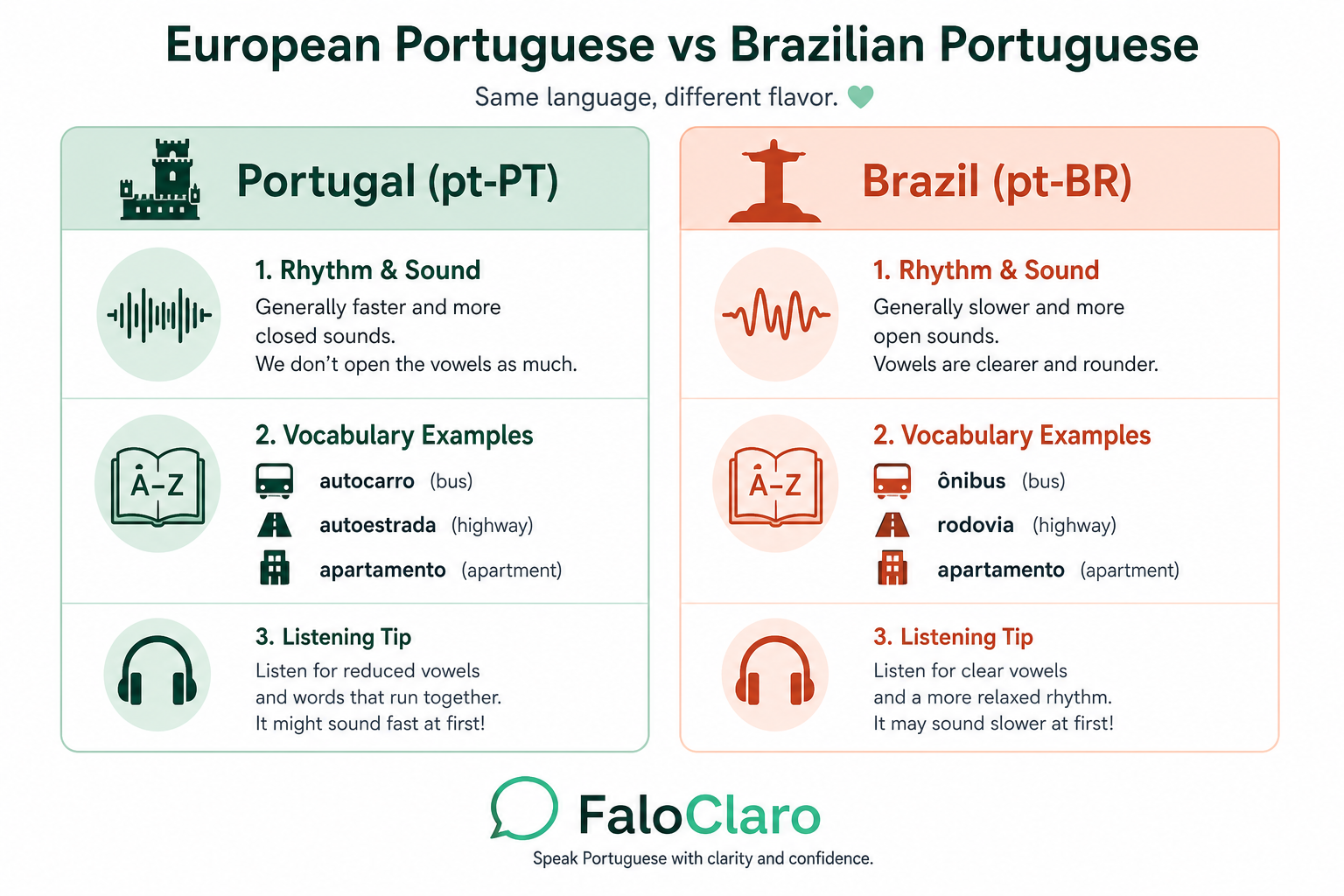
| Area | European (Portugal) | Brazilian (generalised) |
|---|---|---|
| Rhythm | More reduction, compact speech | Often clearer vowels for learners |
| Pronunciation | Many unstressed vowels shrink | Different sibilants & melody |
| 2nd person | tu / você patterns differ by region | você widely default in many materials |
| Vocabulary | autocarro, telemóvel, giro… | ônibus, celular, legal… |
| Formality cues | Service interactions can feel more compact | Materials often more “friendly textbook” |
None of this means one is “more correct.” It means your environment should pick your target.
Decision tree
- Will you live, work, or naturalise in Portugal? → European Portuguese.
- Do you need CAPLE/CIPLE? → European Portuguese.
- Is your life/social circle mostly Brazilian? → Brazilian may fit better.
- Only travelling two weeks? → Either works; learn polite service phrases for where you are.
Rising trend: mixed input
Many learners now consume Brazilian creators and live in Lisbon. That mix is fine if you are deliberate:
- Use Brazilian content for motivation and vocabulary breadth
- Reserve listening/speaking drills for European audio
- Keep a “Portugal word list” for daily life (transport, housing, admin)
What changes first when you switch to pt-PT
- Your ear — café noise + reduced vowels
- High-frequency service verbs — querer, poder, precisava…
- Politeness formulas — se faz favor, com licença, dá-se…
- False friends inside Portuguese — words that exist in both varieties with different everyday preference
Study plan if you already learned Brazilian
| Week | Action |
|---|---|
| 1 | Replace 50% of listening with RTP / pt-PT podcasts |
| 2 | Make a 100-word Portugal daily-life swap list |
| 3 | Record the same monologue in your old accent, then redo slower with pt-PT models |
| 4 | Do one European-style listening mock (exam or lesson) |
For exams and official life
CAPLE assesses European Portuguese. If your goal includes certificates tied to Portugal, do not wait until the month before the exam to “switch accents.”
Bottom line
- Portugal life / CAPLE → European Portuguese as the spine
- Brazilian media → optional supplement, not your only input
- Progress → measured by real conversations and listening, not by which flag is on your textbook cover
FaloClaro focuses on European Portuguese in short Telegram lessons if you want speaking reps aligned with life in Portugal.