

Exam family: CAPLE (University of Lisbon)
Common A2 cert: CIPLE
Variety tested: European Portuguese
Use cases: study, work, residency/nationality pathways (verify your case)
If you are moving to Portugal, applying for certain residency or nationality routes, or need a formal certificate for work or university, you will quickly meet the CAPLE exam family. This guide explains what the exams are, how they map to CEFR levels, where people typically sit them, and how to prepare without drowning in random PDFs.
Always confirm the exact certificate and level your process requires with the official authority (SEF/AIMA, university, employer). Requirements change; this article is a practical map, not legal advice.
CAPLE exams at a glance
CAPLE (Centro de Avaliação de Português Língua Estrangeira) is the University of Lisbon system for certifying Portuguese as a foreign language. The best-known names map roughly like this:
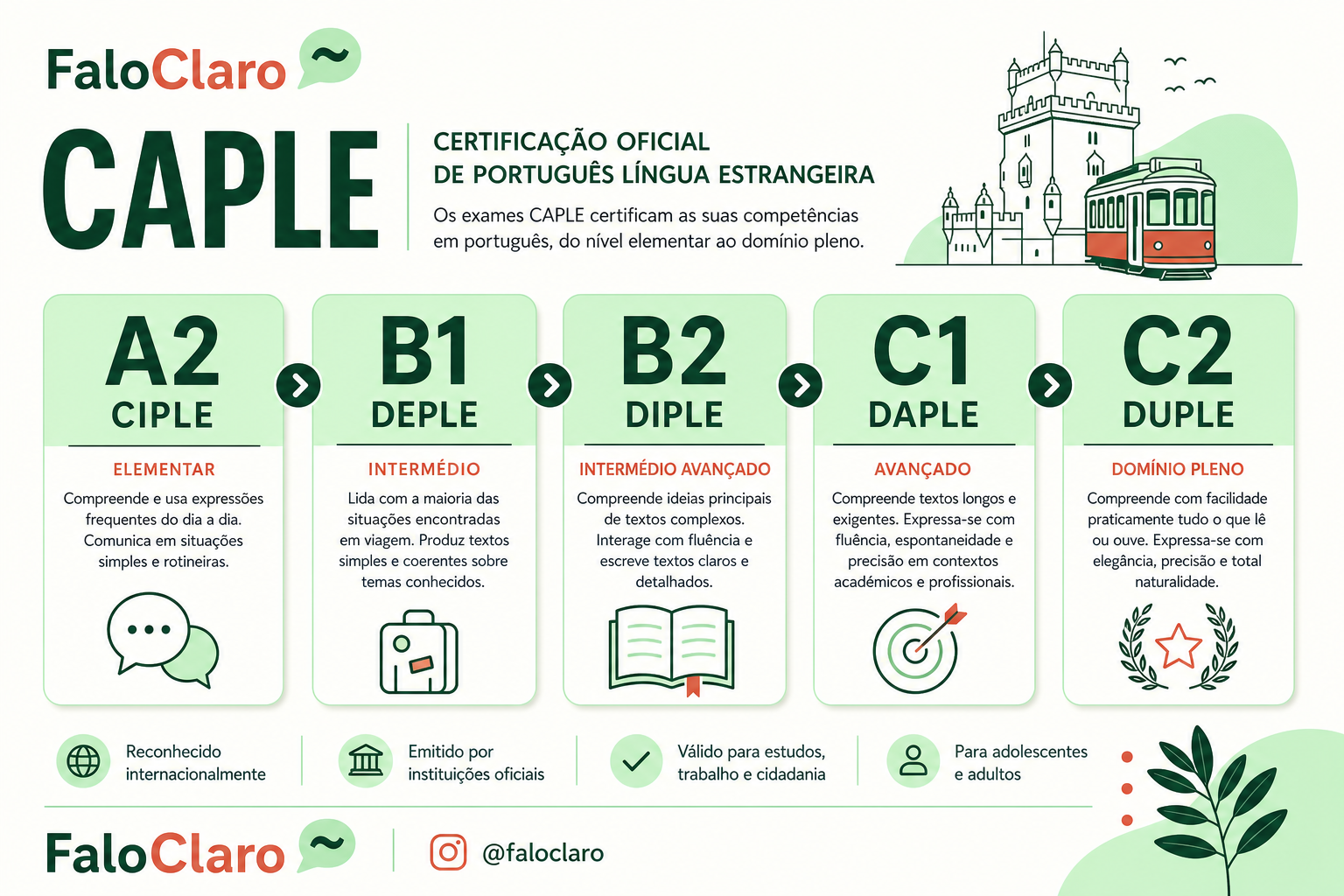
| Exam | Approx. CEFR level | Who often looks at it |
|---|---|---|
| CIPLE | A2 | Residency / nationality pathways that ask for A2 |
| DEPLE | B1 | Independent everyday use |
| DIPLE | B2 | Stronger academic/professional use |
| DAPLE | C1 | Advanced |
| DUPLE | C2 | Near-native mastery |
Exact names, paper formats, and fees are published by CAPLE for each session. Start from the official CAPLE site before you buy any prep course.
What “A2 Portuguese” actually means
Under the CEFR, A2 means you can handle simple, routine exchanges: introducing yourself, shopping, short descriptions of family and work, and understanding slow, clear speech on familiar topics.
For exam day, that usually means:
- Listening to short recordings and answering questions
- Reading notices, emails, or short texts
- Writing a short message or form-style text
- Speaking in a short guided interaction
CIPLE is not a trivia contest about obscure grammar. It rewards clear, useful European Portuguese under time pressure.
Where to take the exam
CAPLE exams are held at authorised centres in Portugal and in some countries abroad. The list of centres and session dates is maintained through official CAPLE channels — not through random Facebook groups.
Practical checklist:
- Open the official CAPLE pages and find the current calendar and centre list.
- Note the registration deadline (often well before the exam day).
- Confirm which modules your centre offers for your level.
- Keep your ID documents ready exactly as the centre requests.
If you live in Lisbon or Porto, you will usually find more frequent options than in smaller towns — but do not assume your nearest language school is automatically an official centre.
How registration usually works
Details vary by centre and session, but the flow is typically:
- Choose exam + date + centre
- Register in the window published for that session
- Pay the fee through the channel the centre/CAPLE specifies
- Receive confirmation and exam-day instructions
- Sit the exam, then wait for results according to the published timeline
Common mistakes
- Registering for the wrong level because a friend “did CIPLE for citizenship” years ago
- Waiting until the last week (centres fill up)
- Preparing with Brazilian Portuguese materials only, then freezing on European listening audio
- Ignoring the speaking module until the night before
How to prepare (a realistic plan)
1. Diagnose your level honestly
Spend one week on:
- 10–15 minutes of European listening daily (RTP, podcasts for learners, slow news)
- Writing 5 short messages (café, appointment, landlord, doctor receptionist)
- Recording yourself answering “Who are you / where do you live / what do you do?”
If you cannot do those without translating every word, stay at A2 prep longer — do not jump to B1 materials for prestige.
2. Build an exam-shaped week
| Day | Focus | Time |
|---|---|---|
| Mon | Listening + short quiz | 25 min |
| Tue | Reading notices & emails | 25 min |
| Wed | Writing (message + form) | 30 min |
| Thu | Speaking prompts aloud | 25 min |
| Fri | Mixed mini-mock | 40 min |
| Sat | Weak-skill repair | 30 min |
| Sun | Light review / rest | 15 min |
3. Train European Portuguese on purpose
European Portuguese reduces many vowels in fast speech. Your ear needs that input. Useful habits:
- Shadow 1–2 minutes of pt-PT audio daily
- Learn high-frequency service phrases (health centre, finanças, transport)
- Prefer materials labelled português europeu / de Portugal
4. Do at least two full timed mocks
A mock is not “reading the answer key.” Sit with a timer, no phone dictionary, and speak out loud for the oral part. Note:
- Where you ran out of time
- Words you kept translating
- Listening items you guessed
What you need on exam week
- Confirmed centre address and arrival time
- Required ID
- Registration confirmation
- Sleep — more useful than cramming irregular verbs at 1 a.m.
- A short list of rescue phrases for speaking (“Pode repetir, se faz favor?”, “Não tenho a certeza, mas…”)
After the exam
Results timelines are published per session. If you pass, store the certificate digitally and on paper. If you miss a module, ask the centre how partial retakes work for your session rules — do not invent a process from a forum post.
A calmer way to prepare speaking
Certificates test performance on one day. Daily life in Portugal rewards short, frequent speaking. If you want a habit that supports exam speaking, practise short dialogues daily — the same skill CIPLE rewards: clear answers about real situations.
FaloClaro is built around that kind of practice (European Portuguese, voice, everyday scenarios). Use it as speaking reps beside your official mocks — not as a replacement for CAPLE registration.
Quick FAQ
Is CIPLE the only exam that matters?
No. It is the widely discussed A2 certificate in the CAPLE family. Your case may need a different level.
Can I prepare with Brazilian teachers?
You can learn a lot, but for CAPLE listening/speaking you still need European input and feedback.
How long does A2 prep take?
It depends on your starting point and weekly hours. Consistent daily practice beats weekend marathons.
Sources
Official CAPLE and Camões pages remain the source of truth for dates, fees, and centres. Cross-check every session there before you pay anyone for “guaranteed” results.